
When the Flag Becomes a Lesson Plan
Mr. Nobody Against Putin, America’s New Patriotic Education Mandate, and the Question Every Parent Should Be Asking

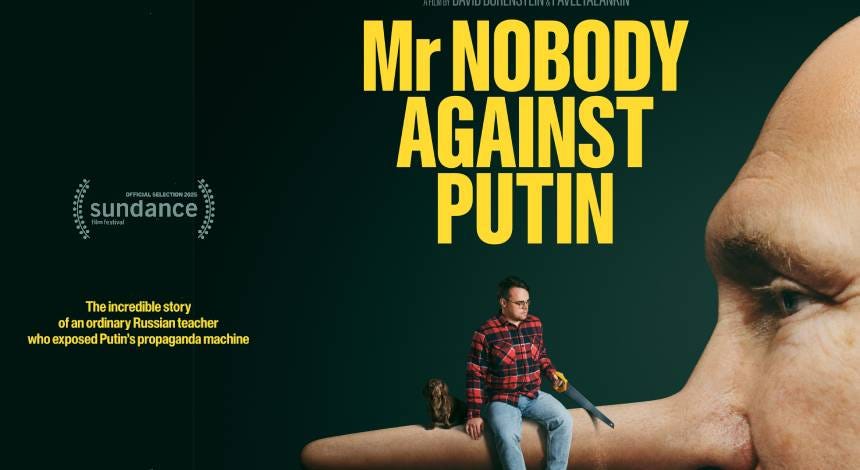
Tonight, a small documentary about a small man in a very small Russian city is competing for the Academy Award for Best Documentary Feature. The film is called Mr. Nobody Against Putin. The city is Karabash — population ten thousand, set in the Ural Mountains, once named by UNESCO as the most toxic place on earth due to fumes from its copper smelting plant. The man is Pavel Talankin, a mild-mannered, bespectacled school videographer known to his students and colleagues as Pasha. He is not a journalist. He is not a politician. He is not a dissident in the tradition of Solzhenitsyn or Sakharov. He is, by his own description, a nobody.
And yet, with a camera bigger than his head and a conscience that simply refused to be quiet, Pasha Talankin documented one of the most chilling transformations of the modern age: the systematic conversion of an elementary school into a factory for state-approved belief. He filmed it for two years. He smuggled the footage out. He fled Russia under police surveillance in the summer of 2024. And now his film is up for an Oscar.
I watched Mr. Nobody Against Putin this week and I have not stopped thinking about it since. Not because it is a film about Russia. But because it is, in ways that should make every American uncomfortable, a film about us.
✦ ✦ ✦
I. A School in Karabash
Before February 2022, Pasha Talankin’s job was joy. He filmed choir practices. Christmas parties. Students doing what students do — laughing, stumbling through recitals, being gloriously, imperfectly young. As the school’s events coordinator and videographer at Karabash Primary School No. 1, his lens was trained on childhood itself.
Then Vladimir Putin launched his ‘special military operation’ into Ukraine. And everything changed.
Almost overnight, the Russian Ministry of Education issued directives requiring schools to hold regular ‘patriotic displays’ — assemblies, recitations, lessons — all built around a state-written curriculum designed to justify the invasion to children. Teachers were instructed which poems to use. Which songs.
Which version of history.
The invasion was not a war. Ukraine was not a neighbor. Russia was not the aggressor. These were the facts children were to absorb, week after week, in the fluorescent-lit classrooms of a thousand Karabashes.
There was a surveillance mechanism built in from the start, almost breathtaking in its bureaucratic audacity: schools were required to upload video footage of these patriotic displays to a state-run portal — proof of compliance, delivered directly to Moscow. Talankin, as the school’s videographer, was the man holding the camera. He was, in effect, conscripted as a propagandist for the regime.
“Love for your country is not about putting up a flag. It’s not about singing the anthem. It’s not about exploitation and propaganda. Love for your country means saying, ‘We have a problem.’” — Pavel Talankin
He thought about quitting. He drafted a resignation. He had the conversation with himself that every person of conscience eventually has when the institution they love begins to serve a master they despise. But then he got in contact with David Borenstein, an American filmmaker based in Copenhagen, and something shifted. He realized that the camera in his hands — the very camera the state had given him permission to carry — was his only weapon. He withdrew his resignation. He kept filming. And he filmed everything.
What he captured is simultaneously mundane and horrifying. A teacher — a member of Putin’s ruling United Russia party — cheerfully tells her students that Western economic sanctions are actually hurting the West more than Russia. Students perform patriotic recitations, bewildered and faintly amused, the way children are when adults ask them to perform feelings they don’t quite understand. Flag waving gives way to grenade-throwing demonstrations. And then — the moment that Borenstein says stopped the room at Sundance — members of the Wagner Group mercenary paramilitary arrive to give a guest lecture to elementary school children.
There is a moment in the film when Talankin documents the funeral of a student’s brother, killed fighting in Ukraine. He turns off the camera. Only sound remains. It may be the most powerful editorial choice in a documentary I have seen in years.
✦ ✦ ✦
II. The View from Washington
On January 29, 2025, President Donald Trump signed an executive order titled ‘Ending Radical Indoctrination in K-12 Schooling.’ The order instructed the Secretary of Education, the Secretary of Defense, and the Secretary of Health and Human Services to work together to enforce what it called ‘patriotic education’ — defined as education with ‘an accurate, honest, unifying, inspiring, and ennobling characterization of America’s founding.’
Within 120 days, the order required the reestablishment of the 1776 Commission — a body first created during Trump’s first term, immediately disbanded by President Biden, and now revived. Its mandate: to promote patriotic education nationwide and advise on the country’s 250th anniversary celebrations on July 4, 2026. The Commission is to be made up of not more than twenty members, appointed by the President himself.
By September 2025, the Department of Education had gone further. Education Secretary Linda McMahon announced the formation of the 250 Civics Education Coalition — a consortium of more than forty conservative organizations, including PragerU, Hillsdale College, Turning Point USA, the Heritage Foundation, and the America First Policy Institute. The coalition was tasked with developing and spreading a new civics curriculum for K-12 schools across the nation. To fund it, the administration redirected $137 million originally earmarked for programs serving minority students.
McMahon explained the rationale plainly: ‘Recently, I saw a statistic that 41% of students, 18 to 29-year-olds, only 41% say that they love America, and that means the balance don’t love America. Why aren’t they proud to be Americans?’
It is a fair question, poorly asked, with a dangerously wrong answer. The solution the administration has settled on — a state-designed curriculum delivered through a coalition of right-wing partisan organizations, backed by redirected federal funds, aimed at producing citizens who feel the right way about their country — is not civic education. It has another name.
Propaganda:
Propaganda is material that aims to push a particular political point of view or agenda, often by using biased or misleading information. Political groups will spread propaganda in order to influence people and serve their own interests.
✦ ✦ ✦
III. The Mirror We Don’t Want to Look Into
I want to be careful here. I am not saying America is Russia. The differences matter enormously. We have a First Amendment. We have a federal system that has, so far, resisted wholesale curriculum takeover — indeed, a law on the books since 1970 explicitly bars the federal government from ‘any direction, supervision, or control over the curriculum’ of public schools. Education Secretary McMahon herself acknowledged this, noting awkwardly that ‘the Department of Education does not control curriculum.’ And yet here she stands, announcing a $137 million grant initiative with a forty-organization partisan coalition to do precisely that.
So no — I am not saying we are Russia. But I am saying that Pasha Talankin’s story holds up a mirror, and I think we should have the courage to look into it.
The mechanism in Russia was deceptively simple. The state did not ban teaching. It did not close schools. It did not even, initially, fire teachers. It merely introduced requirements — regular patriotic displays, a state-written curriculum, mandatory video compliance uploaded to a central portal. It made the camera an instrument of obedience. It made the teacher an instrument of the state. And it did so with the language of love for country, love for children, love for the ‘great civilization’ that is Russia.
“Propaganda works,” Talankin says in the film. “It’s why they do it.”
The 1776 Commission’s first report — produced during Trump’s first term — was described by James Grossman, then executive director of the American Historical Association, as ‘not a work of history’ but ‘a work of contentious politics designed to stoke culture wars.’
Listen to what they say: designed to stoke culture wars.
Historians across the political spectrum found it factually unreliable. It downplayed slavery. It portrayed progressive reformers of the twentieth century as un-American. It instructed that students must speak of America with ‘reverence and love’ and must ‘stand up’ to those who ‘deny her greatness.’
Now the organizations drafting the new curriculum include PragerU — a YouTube channel whose children’s content has venerated Christopher Columbus and Robert E. Lee, argued that climate change is a myth, and classified European fascism as a ‘far-left ideology.’ And Hillsdale College, whose K-12 curriculum has been criticized by educators for depicting the Jamestown settlement as a failed communist colony and offering what one review described as a ‘whitewashed account of US slavery.’
I grew up in New England. I have lived in the Smoky Mountains long enough to understand that patriotism here in Appalachia is a lived, complicated, bone-deep thing — not a lesson plan handed down from Washington. The people of these hills have fought in every American war. They have also been exploited by every American industry. They know their country’s greatness and their country’s failures in equal measure, because they have felt both in their own families, their own bodies, their own communities. That is real patriotism. The kind that doesn’t need to be manufactured.
✦ ✦ ✦
IV. What Might Our Founders Say?
The founding tradition that this administration claims to honor was not, at its core, a tradition of reverence. It was a tradition of argument. Of questioning. Of relentless, sometimes uncomfortable inquiry into whether the institutions claiming our loyalty actually deserve it.
Thomas Paine did not write Common Sense to tell Americans to love their country and stop asking questions. He wrote it to tell Americans that their country, as currently constituted, was a system of inherited tyranny dressed up in ceremonial robes of Royalty and Priestdom — and that they had both the right and the duty to say so. The Founders were not, by and large, men who wanted children taught to feel a certain way about their government. They were men who had just overthrown a King that demanded exactly that.
The tradition — to which Paine, Jefferson, Franklin, and others subscribed — held that reason, not revelation, was the proper foundation of civic life. That a citizen’s relationship to their nation should be built not on sentiment manufactured in a classroom, but on honest examination of history, honest reckoning with failure, and the sovereign exercise of individual conscience. The Truth?
Pasha Talankin understood this instinctively, though he might not have used that language. His great act of resistance was not dramatic. He did not stand on a barricade. He stood behind a camera and pointed it at the truth. He kept asking, quietly, persistently, at enormous personal cost: Is what I am being asked to film actually true? And when he could not square what he was filming with what he believed, he acted.
He lost his home. He lost his job. He lost his country. He is living in exile in Europe, unable to return to the city and the school and the students he loved — the school where his mother still works as a librarian. He did all of this to protect what he called, simply, ‘kids and their ability to have freedom of thought, freedom of expression, and just learn.’
✦ ✦ ✦
V. The Question Every American Parent Should Ask
So here is the question. Not a rhetorical one. A real one.
What is the difference between civic education and civic indoctrination?
I believe there is a difference — a vital one. Civic education teaches children what their country has done, honestly, including the parts that are hard. It teaches them how democratic institutions work, and why those institutions matter, and what happens historically when they collapse. It teaches them to read primary sources, to interrogate evidence, to form their own conclusions. It aims to produce citizens who are capable of self-governance — which means citizens who can disagree, who can dissent, who can hold their government accountable.
Civic indoctrination teaches children what their country means — a fixed meaning, pre-approved by those in power, transmitted through required texts and authorized organizations, funded by redirected federal dollars, assessed against a standard of feeling the right emotions about the right flag.
The difference is not subtle. It is the difference between education and propaganda. And it is precisely the difference that Pasha Talankin documented, frame by careful frame, in a school in the Ural Mountains.
Filmmaker David Borenstein, speaking after the Sundance premiere, drew the parallel directly. ‘Russia’s repression and authoritarianism really kind of accelerated right at the beginning of this film after the invasion of Ukraine, and we’re seeing similar flooding of the gate right now in the United States after its military actions.’ He said this not as a political argument, but as an observation by someone who had spent three years watching how a state rewires a school.
“The conversation that I hope this film brings up is a conversation about resistance. What you’re seeing is a guy who sacrificed his whole life to protect kids and their ability to have freedom of thought, freedom of expression, and just learn.” — David Borenstein, Director
Forty-two states have already proposed or passed legislation restricting how race and history can be taught. Nearly 16,000 books have been banned from school libraries in the past three years, many of them telling the stories of Black Americans, LGBTQ+ people, and others whose experiences complicate the ‘unifying and uplifting’ portrait the administration wants children to see. The books are not being banned because they are factually wrong.
They are being banned because they tell truths that are deemed, by those in power, to be inconvenient.
If you are a parent in America today, I want to ask you something that has nothing to do with party affiliation: Do you want your child taught to love their country? Of course you do. So do I. So does every parent I have ever met, regardless of politics.
But do you want your child taught to love a version of their country that has been pre-approved by a coalition that includes PragerU? That has been funded by dollars taken from programs serving children? That has been designed by an administration that also fired thousands of federal workers, dismantled oversight agencies, and has been openly contemptuous of the very institutions that make self-governance possible?
Do you want your child taught reverence? Or do you want your child taught to think?
✦ ✦ ✦
VI. Mr. Nobody’s Lesson
Pasha Talankin did not set out to be a hero. He set out to be a videographer at a school he loved. He was an ordinary man in an extraordinary situation, and what he did — what he chose to do — was refuse the convenient lie that his camera was neutral, that his compliance was harmless, that small cooperations with large injustices don’t add up to anything.
They add up to everything. That is what the film shows. One flag ceremony at a time. One rewritten history lesson at a time. One Wagner Group mercenary standing in front of ten-year-olds at a time. One child pointing a gun at another.
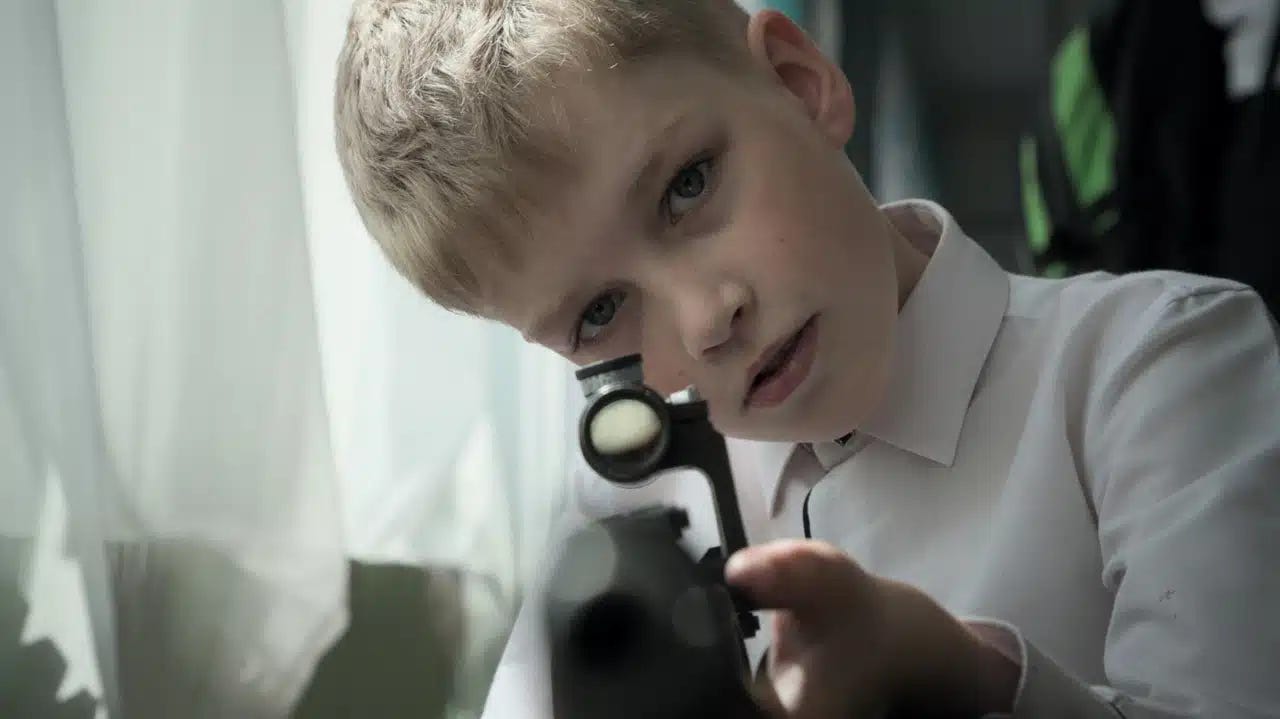
Karabash did not become a propaganda machine overnight. It became one gradually, through the accumulation of small requirements, small compliances, small silences. And the people who made it happen were not monsters. Most of them were, like the cheerful United Russia party teacher in the film, ordinary people who had simply decided that cooperation was easier than conscience. Safer than voicing their thoughts.
That teacher cried at graduation. The film catches it. She is not a villain. She is a warning.
America is not Russia. Our schools are not Karabash. Our children are not, yet, being given grenade-throwing demonstrations by paramilitaries. But we are standing at a recognizable threshold. And a man who has already crossed it, from the other side, is asking us to pay attention.
Mr. Nobody Against Putin is nominated for the Academy Award for Best Documentary Feature tonight. I hope it wins. Not because it is a film about Russia, but because it is a film about what happens when people who should know better decide that going along is easier than speaking up.
Pasha Talankin was a nobody. He had no platform. No political connections. No protection. He had a camera and a conscience, and in the end that was enough.
We are not nobodies. We have votes. We have voices. We have school boards and town halls and legislatures and, on November 4, 2026, ballot boxes. We have every tool Pasha Talankin did not have, and a few he did.
The question is what we intend to do with them.
✦ ✦ ✦
Walter Cook is the author of When the Sky Fell on the Mountains, The Ruff Patch, Sanctuary, 328734 and the Mahjong Murder Mystery series. He lives and writes in Franklin, North Carolina. His forthcoming literary novel, The Book on the Bench, will be published in 2026.
Mr. Nobody Against Putin is now streaming on the Kino Film Collection and can be seen on Amazon Prime. It is nominated for the Academy Award for Best Documentary Feature at the 98th Academy Awards, March 15, 2026.
Sources: The Moscow Times, NPR, Kino Film Collection, Variety, Wikipedia, The Fulcrum, Education Week, Common Dreams, World Socialist Web Site, The White House Executive Order (Jan. 29, 2025), Grand Pinnacle Tribune, Washington Examiner, Truthout, Daily Californian.